“And still they hear the craiking sound
And still they wonder why—
It surely can’t be underground
Nor is it in the sky”
— John Clare, The Landrail, 1832
A Missing Voice
In the archive of the Dales Countryside Museum in Hawes, there is a bird list. It was compiled by Marie Hartley — writer, illustrator, and devoted chronicler of life in the Yorkshire Dales. Between 1934-1937 Hartley recorded sixty-six different bird species present near her home in Askrigg, Wensleydale.
Of those sixty-six, sixty-five still have a foothold in the Dales today. Some of those such as merlin, woodcock and ring ouzel are on the red list of conservation concern. But the fact so many are to be found at all indicates how supportive the environment remains to birds and wildlife in general. The one bird that is now completely absent however – is the corncrake.
Corncrakes were once common across the much of the British Isles but vanished from many places over a relatively short period. The last confirmed nesting of a corncrake in the National Park occurred in 2002 at a location that was undisclosed to the public. The pair that appeared unexpectedly were aided by conservationists and local farmers to protect the nest and chicks. But no birds returned the following year or in subsequent years.
Infrequent Fliers
Corncrakes belong to the rail family, which comprises over 150 species found on every continent bar Antarctica. The familiar moorhen and the blue purple swamphen of the Mediterranean marshes are both rails. The family are among the most widespread birds on earth, and most are associated with water or a wetland environment.
The corncrake is unusual for its preference for habitats such as upland wildflower meadows, the likes of which used to be fairly common in pre-war Britain.
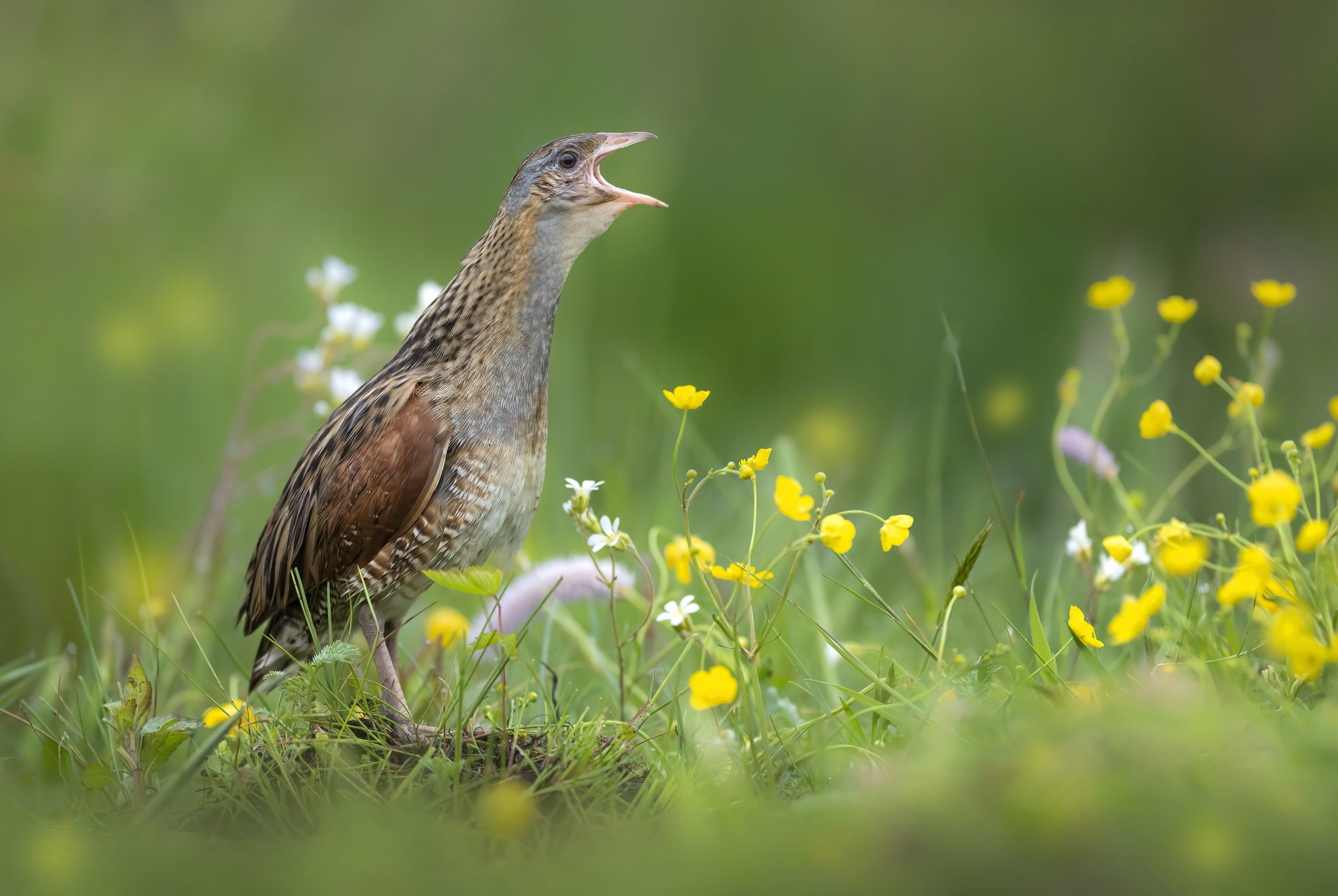
The bird is about the length of a partridge, with warm buff and chestnut plumage. It is incredibly secretive, and is perhaps most famous for its rasping call, used by the male to attract a mate. Its Latin name, Crex crex, somewhat mimics the sound, which is heard from dusk till dawn during the breeding months of May, June and July.

The body of a corncrake is slim and perfectly designed for slipping through stems at ground level, and when disturbed this is usually how it reacts. Victorian naturalist William Sterland observed:
“I have never succeeded in causing the corncrake to take wing except with a dog, and even then its flight is always brief, as it takes an early opportunity of dropping back to the ground.”
Yet the corncrake can and does fly vast distances during its migration from central and southern Africa to the Eurasia. It spends as much as a third of its life migrating, covering 2,000–3,000 miles each way. Corncrakes rarely live longer than three years, which makes each breeding season critical for sustaining populations.
In April, returning birds often revisit the same area, meadow or field. The female hatches her eggs and raises the chicks alone, and will often leave her first brood to fend for themselves at just twelve days old in order to find another male and begin a second nest. Corncrake chicks look quite unlike their parents and are covered in jet-black downy feathers, almost resembling moorhen chicks.
The Little Gods of the Field
The corncrake’s name derives from the Old Norse krâka, meaning crow – so “corncrake” may originally have meant “corn crow,” a reference to the call’s harsh, corvid-like quality rather than any resemblance to the bird itself..
In Gaelic tradition the corncrake accumulated rich folklore. Rural communities called them the “little gods of the field” — their presence associated with traditional farming, and the first hearing of the call in spring taken as an omen of a good harvest to come. A field with corncrakes was a field in good heart. The phrase codladh an traonach chugat – the sleep of the corncrake – became a traditional Irish expression for a restless, sleepless night, an acknowledgement that a male corncrake in full voice, calling thousands of times between dusk and dawn, was not a sound that encouraged rest!
Because the birds seemed to appear magically in the tall grass each Summer and vanish without trace each Autumn, rural communities in Ireland and Scotland puzzled over where they went. Some believed they hibernated underground; others that they transformed into moorhens; others still that they rode south on the backs of larger migrating birds.
It was not until the age of ringing and tracking that the truth emerged — that this apparently earthbound creature was crossing the Sahara twice a year, travelling to the Congo basin and back. The folklore, for once, was less strange than the reality.
A Story of Loss
In Victorian times, so common were corncrakes that Mrs Beeton included a roasted corncrake recipe in her famous household guide. Prime Minister Stanley Baldwin, speaking in 1924 pronounced “the corncrake on a dewy morning” as one of the defining sounds of rural Britain, alongside the blacksmith’s hammer and the sound of church bells.

A familiar visitor to farms and meadows from Cornwall to Caithness, corncrakes are thought to have been common in the Dales and elsewhere until the early 1900s.
The first significant declines came in the 1920s and just a decade or so later, although the bird was still a visitor in most counties, it was becoming notably scarcer.
In the early 1950’s ornithologists such as Ralph Chislett, author of Yorkshire Birds, were recording the bird as effectively gone from the Yorkshire’s lowlands. Chislett observed that they had “all but disappeared as a breeding species in south and central Yorkshire,” and that “fewer corncrakes were noted during the year (1952) than water rails – which would have been impossible in my younger days.”
By the 1970s, corncrakes were mainly restricted to the northern and western fringes of Scotland, with the highest concentrations on the Hebrides and Orkney. A few scattered outposts remained in places such as the West coast of Ireland and the Derwent Valley in northern England where suitable habitat remained intact. The breeding population in the UK as a whole had collapsed to around 400 calling males.
Today the count is believed to be somewhat healthier, with between 800 and 900 breeding males returning each summer.
So what lay behind the species’ decline?
Machine in the Meadow
For a long time corncrake and man had existed in relative harmony, each able to get what they needed from the land they often shared. But when farmers across Britain began making silage as an alternative to hay, the calendar for harvesting meadows and grasslands jumped forward six to eight weeks, impacting the period corncrake females were incubating eggs and tending newly hatched chicks.
Farmers adopted silage making as the crop was richer in nutrients than hay for feeding livestock, and cutting earlier reduced the risk of damage from a prolonged spell of poor weather. Mechanisation then accelerated the speed of harvesting – a tractor-drawn cutter could clear an area in hours that would have taken a team of men with scythes or a horse-drawn cutter multiple days in some cases.

Although adult birds could survive disturbance, the nests they abandoned were almost always destroyed and as silage-making became widely adopted, corncrake numbers fell.
The new intensive methods affected other ground-nesting species too – species such as curlews, skylarks, yellowhammers and lapwings all lost nesting sites. But the corncrake, a long cover specialist, was unable to adapt in the way other species could and paid the highest price for the changes.
Evensong

Places such as Wharfedale, Wensleydale, Swaledale and Littondale, with their rich tradition of upland wildflower meadows, would have been ideal corncrake habitat historically. For the dalesfolk, the rasping call of the corncrake would have been as much a herald of the new season as the curlew’s call is today.
Marie Hartley would have been aware that the corncrakes she and local people heard near Askrigg were already far less common than they had once been. The bird she noted on her list in he the 1930’s was already in retreat and within a decade would be considered no longer a visitor to her home dale.
Yet older members of farming families in Yorkshire and parts of Ireland still remember vividly the sound of corncrakes in the fields on warm June nights. They relate how it would be heard whilst coming home across the fields after dark. The sound was so distinctive it apparently still echoes in the collective memory.
The corncrake may be gone from areas it once thrived, but it has not been forgotten and efforts have been made to reinstate and conserve such an emblematic presence. There has been success in selected areas.
A Slight Return
The cornerstone of corncrake conservation across the UK is the Corncrake Initiative, championed by the RSPB and supported by the National Lottery Heritage Fund. It pays farmers and crofters to delay silage and hay cutting until August — restoring, in effect, the old calendar that the corncrake evolved alongside.
Within the scheme, conservationists work directly with landowners to create what might be called a corncrake landscape — varied patches of plant cover within and around open meadow. Clumps of nettles, cow parsley and yellow iris planted along field boundaries are encouraged and provide essential early cover for arriving adults before the meadow grasses have gained summer height.

Cutting from the centre of a field outward is also encouraged rather than the other way around. Ideally this change pushes birds and chicks safely toward uncut margins rather than herding them into a tightening circle. A simple adaptation but one that makes a critical difference to survival rates.
The evidence that these methods work is arriving from the island strongholds where corncrake conservation is given high priority. According to RSPB Corncrake National Survey Data, after a sustained 30% decline in Scotland between 2014 and 2022, the 2023 survey recorded the first increase in five years – cautious but genuine grounds for optimism.
On the Isle of Skye for example, the Skye Crofting and Corncrake Partnership recorded 27 calling males in 2024 — up on the previous year. And on Rathlin Island off the coast of Northern Ireland, similar practices have produced comparable results, with Raithlin now holding a slowly but steadily increasing population.
In England, the picture is still fragile. A captive rearing and release programme – carried forward by the Deepdale Conservation Trust in Norfolk – has seen wild-bred corncrakes return to breed for the first time in over fifty years. The Norfolk population has grown from just three calling males in 2021 to at least nine in 2024. Slow progress, but proof nonetheless that reintroduction can work in England too.
In Yorkshire, all of these threads are now being drawn together. The Friends of the Lower Derwent Valley launched their own reintroduction programme in 2025 – seventy-four chicks were released in the first year alone. The target is a stable, self-sustaining mainland population with birds returning of their own accord, breeding and gradually spreading into suitable habitat.
The Yorkshire Dales, which are home to over a quarter of Britain’s remaining upland hay meadows, seem a logical next location for a reintroduction effort. Places such as Swaledale, Arkengarthdale, Dentdale and Wensleydale might just hold the key to the a more optimistic chapter in the corncrake’s story.
How fitting would it be for the sixty-sixth bird on Marie Hartley’s list to return at last – for the missing voice of the Dales to be heard again on Summer nights.
Now that would be something to crow about.


