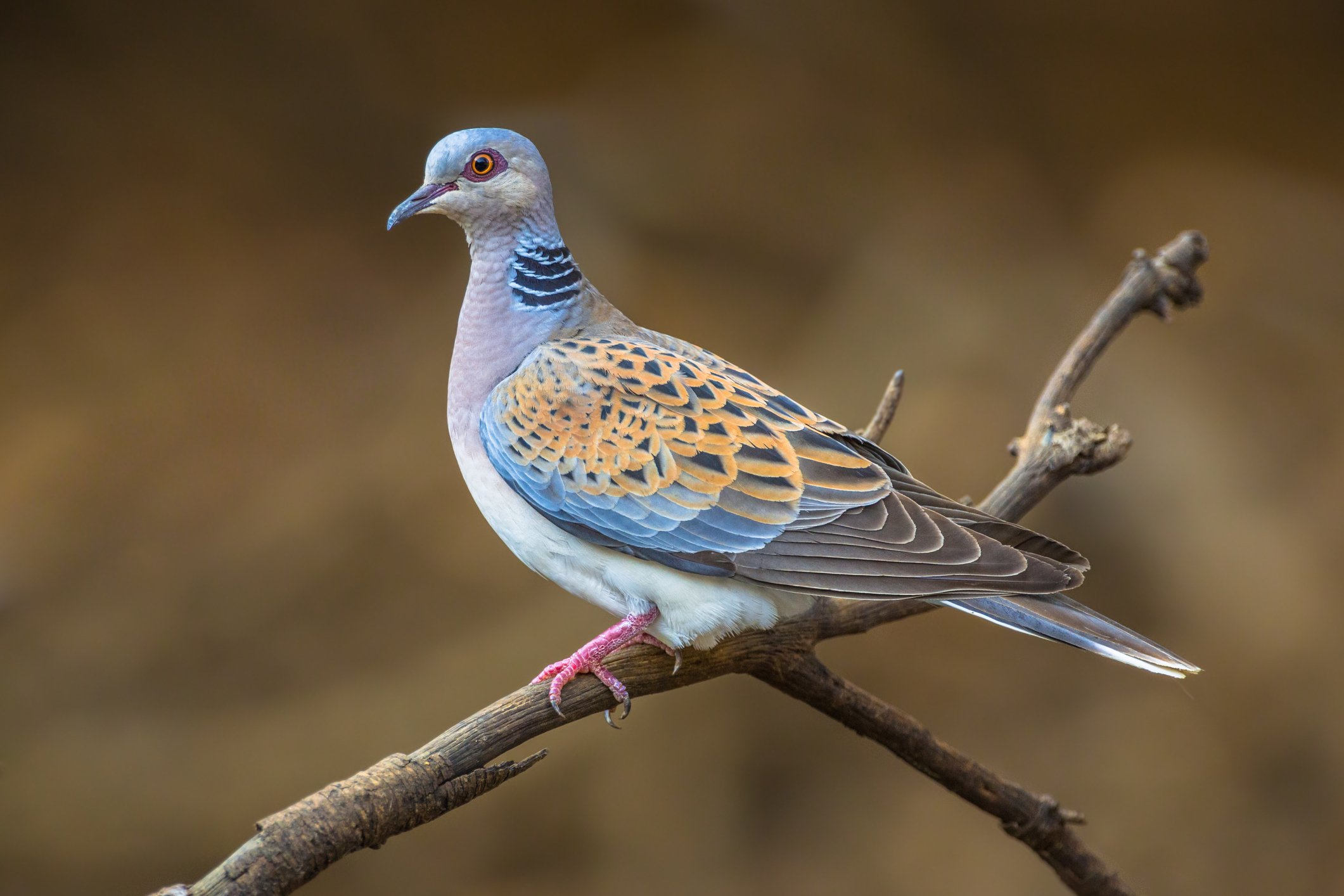
O yonder doth sit that little turtle dove,
He doth sit on yonder high tree,
A-making a moan for the loss of his love,
As I will do for thee, my dear,
As I will do for thee.
Traditional English ballad, collected by Ralph Vaughan Williams
at the Plough Inn, Rusper, Sussex, 1905
There is a pilgrimage in England for a bird.
It passes through the lanes and hedgerows of Sussex, carrying a song. People come from across the country to walk it. They sleep in a church. They sing to wells, to ancient oaks, to strangers in village streets and even to a grave. At the end of their journey, they stand at the edge of a wild place, an oasis, and listen. What they hope to hear is a sound which was once relatively common: the purring, soporific call of the Turtle Dove.
The pilgrimage is the creation of Sam Lee, the folk singer and song collector, working alongside Will Parsons of the British Pilgrimage Trust. Together they lead a small group – never more than a handful of walkers – from the Plough Inn at Rusper, a West Sussex village pub, on an eighteen-mile journey to the Knepp Estate. It is, in Lee’s own words, an attempt to “re-wild” one of Britain’s oldest folk songs, returning it to the very birds that inspired it centuries ago.
The Turtle Dove, Streptopelia turtur, is smaller and slimmer than a Collared Dove, its wings a warm cinnamon-brown patterned with black, its breast a soft vinaceous pink. The sides of its neck carry a distinctive black-and-white striped patch like a small silk cravat and it was once as much a part of Summer as the Swallow or the Cuckoo.
It is a farmland specialist, and today sits on the UK Red List – the highest level of conservation concern. Fewer than 2,000 territories remain, confined to the southern and eastern counties of England, with the strongest populations in East Anglia’s Brecks and across the south-east. A bird that was once the sound of every English Summer now purrs from a dwindling number of hedgerows in Kent, Suffolk and Norfolk.
The Oldest Symbol

The Turtle Dove deserves a pilgrimage. The bird’s story transcends three thousand years of literature, traverses a flyway that extends from West Africa to the Suffolk coast, navigates the labyrinthine farmland politics of the European Union, and graces unspoiled corners of the English countryside.
Fidelity. Spring. Sacrifice. Love that endures across impossible distances, and the return of life after a long absence are all themes the Turtle Dove has carried across the cultures it has touched. Turtle Doves seek out the same partner each Spring, for as long as both birds survive. Reunited pairs demonstrate obvious affection, sitting close and preening one another in true ‘lovey-dovey’ fashion.
Their time together is hard won. The male and female migrate separately. For a pair to find each other again in Spring, both birds must survive everything that migration and prolonged time apart over Winter throws at them. Theirs is a partnership tested to by time and distance to an extreme degree. Not every Spring brings a reunion.
In nature the turtle dove appears to mourn the loss of its partner, and this behaviour likely inspired the myth that a widowed turtle dove would refuse to drink from a pool of still water, because its reflection would elicit memories of its late beloved.

Little wonder, then, that the Turtle Dove has been so romanticised throughout history. The Song of Solomon – an epic poem of longing and reunion, thought to date around the tenth century BC, reaches for the Turtle Dove at its most ecstatic moment. The lover, calling to his beloved, says:
For, lo, the winter is past,
the rain is over and gone;
the flowers appear on the earth;
the time of the singing of birds is come,
and the voice of the turtle is heard in our land.
Song of Solomon 2:11-12 (King James Version)

The poem uses the Turtle Dove’s arrival as the signal that Spring has not truly begun until the Turtle Dove’s voice is heard in the land. This text was chosen as a reading at the wedding of Prince Harry and Meghan Markle in 2018, reaching a global audience of millions, proving the power of the bird’s symbolism remains strong today.
The Greek natural historian Aelian, recorded that white Turtle Doves were sacred to Aphrodite, the goddess of love, and were observed and protected within her sanctuaries. At her temple at Eryx in Sicily, accounts describe great flocks of doves departing each year with the goddess herself, before a single bird returned first across the sea, followed by the rest of the flock.
William Shakespeare returned to the Turtle Dove an emblem of faithful love. In The Winter’s Tale as Florizel courts Perdita he says to her “So turtles pair, that never mean to part”. Elsewhere in the same play, a bereaved husband speaks of himself as “an old turtle” who will “wing me to some withered bough and there, my mate, that’s never to be found again, lament till I am lost.”
Shakespeare took the symbolism to its extreme in The Phoenix and the Turtle of 1601 – a poem in which the Turtle Dove dies alongside the Phoenix and their union becomes a meditation on the nature of perfect love, the merging of two souls into one. It is one of the most unusual things Shakespeare wrote, and the fact that he chose the Turtle Dove as the Phoenix’s partner in transcendence is a measure of how the bird was regarded as a creature of devotion.
A Ballad Reborn
Voice and song play a key part in the pilgrimage.
Participants do not simply go in search of a bird. They carry something to it — an ancient folk song, passed down through history, that seems to speak to the dove in its own voice.
In the Autumn of 1905 composer Ralph Vaughan Williams arrived at the Plough Inn with a phonograph machine, sat down with the landlord and recorded him singing. What David Penfold performed for him that day was a song of unknown provenance called The Turtle Dove. Vaughan Williams preserved the recording, and in time arranged a composition for solo baritone and piano – a setting of such poignancy that it has never left the choral repertoire.
The recording survives and can be heard in the British Library Sound Archive: the voice of a Sussex innkeeper, slightly wavering through a century of static, singing a haunting ballad with the symbol of the Turtle Dove at its heart. Like many very old folk songs, it cannot be attributed to any individual, but the lyrics are well established and constitute perfect dove-serenading material for later in the walk.

Before a step is taken though, participants gather in the churchyard at Rusper and sing a rendition of The Turtle Dove to two graves set close together. One belongs to Penfold, the landlord who sang into Vaughan Williams’ phonograph. The other to Lucy Broadwood, a song collector,who collaborated with Vaughan Williams on several projects.
From there they go on singing it – at wells and ancient boundary oaks, in village streets to startled shoppers who did not know a pilgrimage was passing through, and at every resting point along the twenty miles or so until they reach the Knepp Estate, their final destination, where it is hoped male Turtle Doves are tuning up with their own vocalisations as they establish territory and reaffirm the bond with their mate.
Sam Lee, who leads the walk, has written of “the ‘broadcasting’ of sonic heirloom seeds” as an attempt, in his words, “to restore and reinvigorate that ancient and intuitive coexistence with which our known… folk songs and the patterns of Nature have evolved.”
The Longer Journey
As the pilgrims wend their way melodiously through Sussex, the June evenings offer an opportunity to discuss the finer points of pilgrimaging, and to ponder what the Turtle Dove itself must navigate in the course of its own much longer journey and the difficulties it faces after arriving.
Once the birds leave the Sahel they head north across the Sahara, the Mediterranean, and the length of Europe to reach their breeding grounds. But on the way they must also run the gauntlet – and for decades that gauntlet has been lethal.

Until 2019 roughly one million Turtle Doves were shot legally each Autumn across Spain, France and Portugal, with an estimated 600,000 birds killed illegally each year along the wider Mediterranean migration route.
Conservation pressure led to a hunting moratorium across the western route from 2021 which saw European breeding population rise by roughly 40%, an increase of some 615,000 pairs, taking the total to around 2.13 million.
In April 2025, the European Commission permitted EU countries to reopen hunting in parts of western Europe, citing population recovery. A quota of 132,000 birds was agreed with specific allocations for each country. Conservation bodies opposed this strongly, arguing that enforcement systems remained weak – one of the three conditions required before lifting the ban which they pointed out had not been met.
The core unresolved issue on the continent remains enforcement, with campaigners pushing for the 2025 quota to be reversed or tightened, and for genuine monitoring infrastructure across the western flyway before any further hunting expansion is permitted.
At home, Operation Turtle Dove — led by the RSPB alongside Natural England, Pensthorpe Conservation Trust and Fair to Nature — has spent over a decade working with farmers in south-east and eastern England, helping them restore the weedy, flower-rich field margins the bird depends on for food, especially the seeds of common fumitory. In 2024 alone, 442 landowners signed up to take part. A government scheme reopening in June 2026 will help fund this work on more farms still.

The bird makes no distinction between jurisdictions. A Turtle Dove saved on a Kent farm and lost over a Spanish hillside is not a bird saved. Hope for the species has to travel the whole flyway, or it travels nowhere at all.
Arriving in Silence
Three days, twenty miles and several renditions of The Turtle Dove after leaving Rusper, the pilgrims finally arrive at their destination – the 3500 wild acres of the Knepp Estate. Having risen and arrived early in order to coincide with peak calling time, their first priority is to listen – to hear whether any Turtle Doves have made it back to the area.
Estate owners Charlie Burrell and Isabella Tree, stopped farming Knepp conventionally in 2000 when farming it profitably became impossible: fences came down, free-roaming cattle took over from machinery, and the land was allowed to become what it wanted to become. What it wanted to become, it turned out, was an oasis – a breathing space for plants, insects, wildlife and birds, including Turtle Doves, with numbers rising from a single territory in 2005 to 23 singing males in 2020.

As the light begins to feel its way across the Weald, the pilgrims sing The Turtle Dove one final time to the land, and to whatever might be listening within it. Sam Lee has called it “this utterly profound moment of bringing the song back to its rightful muse.” Then they wait.
Sometimes a Turtle Dove responds. Sometimes it doesn’t.
The sound the Turtle Dove makes is unlike any other bird in the British countryside – a deep, soporific purring felt as much as heard. It is not a song in the conventional sense and has nothing of the Blackbird’s range or the Skylark‘s flamboyance. It is simpler: a churr, with a flute-like quality, that pulses through everything around it.
There have been occasions where pilgrims have ended their journey wondering whether the ‘The Turtle Dove’ ballad is becoming an elegy. But people return in subsequent years regardless, armed with more ‘sonic seeds’ to cast for the future of the species.
A Blueprint for Return
Knepp has shown what happens when land is released to nature and managed lightly – a recovery that exceeds expectations. The European moratorium showed something else: that reducing hunting pressure, even temporarily, can return rapid results. Together, they sketch the outline of a workable blueprint — one that needs political will, international cooperation and patient effort to complete, but whose components have already been proven.

In the UK the habitat work is helping build the conditions for recovery — fumitory-rich field margins, an expanding farm network with the Sustainable Farming Incentive for amenable landowners reopening in 2026. But the birds have not yet arrived in the numbers that would confirm their future is guaranteed. The next full national survey, also due in 2026, will be the first real measure of whether a decade of conservation effort has begun to move the needle.
The Turtle Dove is not a dramatic species — not a bird of prey or a rarity that draws crowds for its size or flying speed, though it is quietly beautiful. Its significance is cultural, carried across millenia of literature, scripture and song. It asks nothing of us except the conditions it needs to exist: a weedy field margin, a dense hedgerow, a drinking pool, and a migration route it can survive.
There is a pilgrimage in England for a bird.
A new dawn for the Turtle Dove is its destination.

