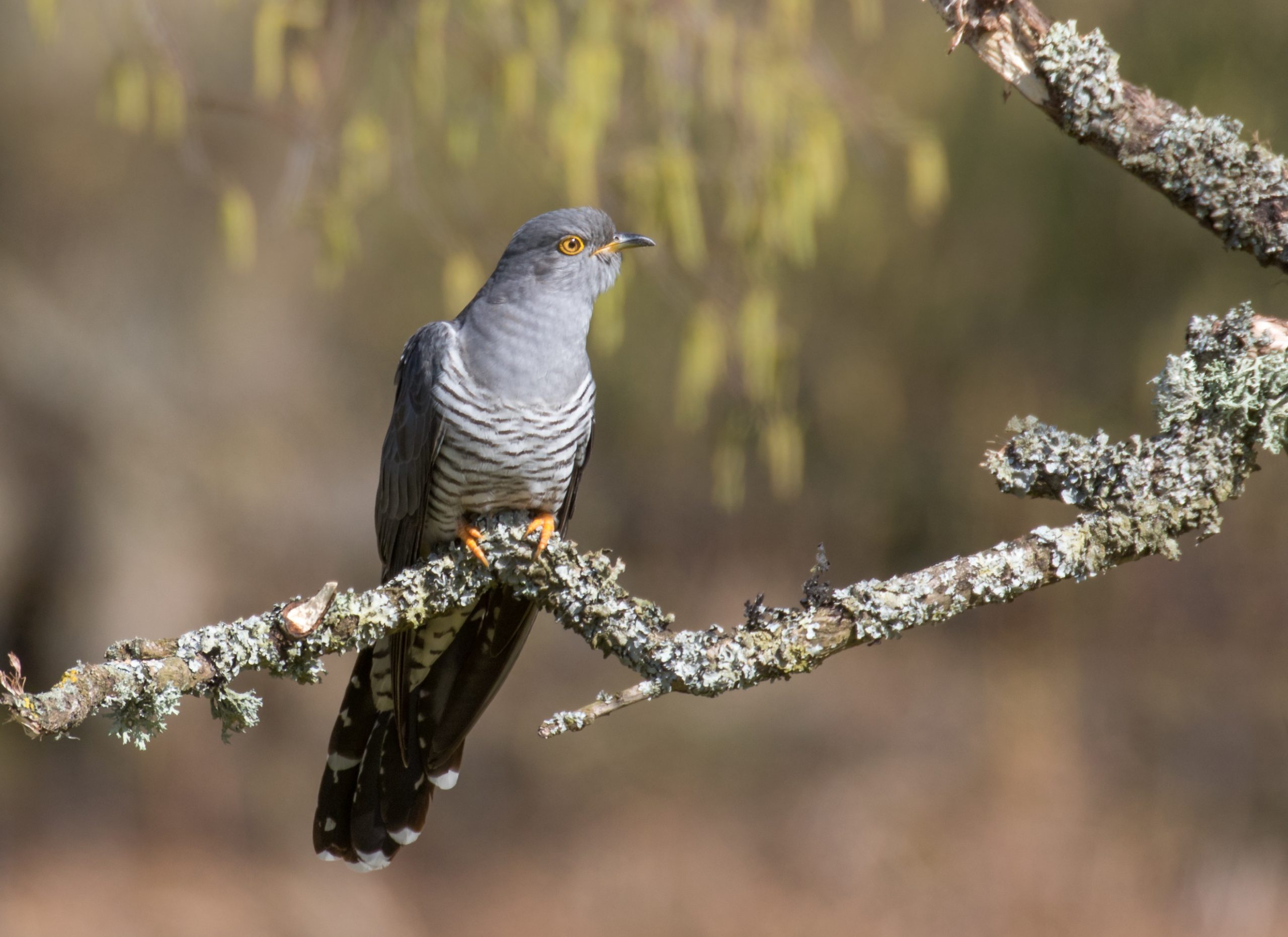
The Cuckoo — Five Thousand Miles to a Yorkshire Dale
It’s early morning in Langstrothdale in the central Yorkshire Dales. The skies are blue and spring is finally gathering momentum. After a journey of some 5,000 miles, the cuckoo is back.
His call lifts from the stand of pines just across the infant River Wharfe — and in the absence of any other sound, lingers in a way that might well be described as otherworldly. The sound carries down the chase to Swarthghyll Farm, and up to Oughtershaw, and even to Beckermonds a mile or so away. The whole upper dale is a listening chamber, and the cuckoo knows it.

The call belongs to the male. The female produces an altogether different sound – a soft, liquid bubbling that is rarely heard and which serves multiple purposes relating to mating and egg-laying. Having arrived back in his territory, the male is announcing himself to every rival within range, reaffirming his claim to this corner of the Dales.
Cuckoos are highly site-faithful. Individual birds return to the same territories year after year, navigating back from sub-Saharan Africa — a round trip of thousands of miles — to within a few kilometres of where they bred the previous year.
The cuckoo heard in Langstrothdale each spring is very likely the same bird, or the offspring of a bird, that arrived here in previous years. Females also tend to return to the area where they themselves were raised, perpetuating a kind of local tradition passed down through generations.
The cuckoo is not the only visitor that reaches our shores in spring after an epic migration. Others arrive whose journeys are no less demanding. The spotted flycatcher, the redstart and the hobby all start appearing in Britain in late April with arrivals continuing into May.
The Hobby — Built for Speed
The hobby is the quickest of them — a falcon rather than a songbird it is built for speed, which it puts to use for its migratory journey as well as hunting. It winters in southern Africa — Angola and Zambia especially — and covers around nine thousand kilometres, crossing the Sahara before setting its sights on Europe.
Above the desert it flies at roughly double its normal cruising speed, clocking around four hundred kilometres a day. At altitude, the desert’s powerful winds become an invisible conveyor, assisting the bird across vast expanses of nothingness until it reaches relative safety.
It is not fazed by the Mediterranean either. One tracked individual flew seven hundred and forty kilometres of open sea in a single unbroken flight of twenty-seven hours. Through day, through night and through day again until the faint horizon of land finally draws into sight.

Having navigated these two great natural barriers it continues over mainland Europe. Those that come arrive here, arrive lean, purposeful and lethal, hunting the first dragonflies before they have even landed. To the hobby, even swifts and swallows are fast food opportunities and hatching dragonflies are an essential supplement necessary to rebuild condition.
The hobby hunts is so adept in the air it even eats on the wing. Watch one long enough on a dry afternoon and you will see the adept talon-to-beak transfer of prey that saves it the bother of landing.
The Redstart — A Winter Slowly Unveiled
Common redstarts also hail from Africa. By the time male redstart arrives on our shores in April his breeding plumage has already unveiled itself – the pale feather tips that concealed it all winter having slowly worn away. You might call it a redstart — but by the time it arrives, it is more of a red-finish.
Like the cuckoo, it too has to cross the vast Sahara. But where the cuckoo’s winter home is deep in the Congo, the redstart spends its southern retreats in the Sahel – a band of scrub and grassland that stretches across, south of the Sahara.

From there it navigates north through Mauritania and Morocco, traverses the Strait of Gibraltar or the western Mediterranean, continues up through Spain and France, and then hops across the Channel. The oak and hazel woodlands of the Dales, the Welsh valleys and the Scottish glens are some of the places it prefers when it raches our shores.
And so it is that a bird weighing not much more than a letter propels itself some two thousand miles to take up residence in the temperate woods of western and central Europe. Like the cuckoo’s the redstart’s stay is also brief. It arrives mid to late April, and is gone again by September – occasionally remaining til October. Having arrived as the bluebells flower it departs before the bracken has turned.

Once here, the male redstart’s priority is to establish territory, singing prominently from exposed branches. He chooses a nest site and then, when the females arrive a few days later, goes into full courtship mode — displaying the burning colours of his tail, chest and fanned wings, performing zigzag flights between the trees, showing potential mates around prospective nest holes with considerable enthusiasm.
Once established, a redstart nest’s will sometimes be parasitised by a the cuckoo. The cuckoo chick, so much larger than its nest-mates, might be expected to crowd them out. But research has shown it inadvertently keeps them warm, acting as an unlikely hot water bottle for the redstart chicks huddled alongside it.
Two Sahara-crossers, their destinations and destinies entangling in a remarkable way.
The Spotted Flycatcher — Last to Arrive, Furthest Travelled
Last but not least, the spotted flycatcher starts arriving. These unassuming birds start trickling through in late April and continue arriving into the middle of May.
Its quiet demeanour belies its toughness. It comes from even further away than the redstart, hobby or cuckoo, with some individuals wintering as far south as Namibia. Like the redstart, the flycatcher makes its journey in short hops, feeding as it goes, navigating up through Africa and across the Mediterranean one leg at a time.
The Mediterranean is by far its greatest challenge. The key to traversing it successfully is astute weather-watching and generous pre-fuelling. Birds load up at staging posts on the North African coast, wait for favourable conditions – tailwinds and clear skies – then commit to the crossing.
If the wind picks up or changes direction, or reserves run low, the birds must resort to whatever rest opportunities that are available for refuge. They have been recorded landing on ships mid-Mediterranean in such conditions, hunting flies and moths on deck before continuing on.
Its departure window from Africa is dictated by day length rather than more variable environmental factors as with other birds. That means it leaves and arrives within a specific time window, whatever the broader seasonal picture. Whatever May in Britain has waiting for it – a late frost or early warmth, abundant insects or a cold snap – it must trust the conditions will sustain it.

Spotted flycatchers often return not just to the same woodland or garden, but to the same wall, branch, or fence post they left the previous September. They like to survey familiar terrain from familiar viewpoints and hunt the same airspace. Listen out for the snap of the beak when it feeds — the most obvious audible sign it is back in residence. its songs and calls being high pitched and indistinct.
Flycatchers do indeed catch flies, and a great deal besides. Their diet includes wasps and bees, butterflies and moths, grasshoppers, bugs and beetles — essentially anything with wings that passes within range. Cannily, they remove the stings of wasps and bees by beating them against a hard surface before consuming them.
To the east of Britain, the same bird is simultaneously dropping into woodland edges, old orchards and sunlit churchyards across France and Germany, all the way through Russia and Central Asia to the forests of Mongolia — a longitudinal span that covers nearly half the globe. When one lands on your garden wall in May, it is the westernmost ripple of an arrival playing out across an entire hemisphere.
Cuckoo, Hobby, Redstart and Flycatcher: together these four very distinctive birds are part of a wider migration pattern from south to north that has been playing out for millennia. Each spring the same imperative stirs in the same species, and the same journeys begin again.
You probably don’t need to travel far yourself to welcome them back again. A quiet moment in a woodland clearing or an afternoon in a mature garden can yield sightings of more than one of these species in a single outing.
The sound of the cuckoo will find you before you find it. The redstart will reward a little local knowledge. The hobby’s distinctive outline will reveal itself over water or open heath on warm afternoons. And the flycatcher will reward your wait beside its favourite perch — just as an insect-rich garden might encourage one to take up a residence nearby.
There are a host of much loved summer visitors that start arriving in Britain from now, not just hobbies and redstarts, but swallows and warblers too. They are recognisable not just for the variety and colour they bring to our shores but also for the incredible journey each has completed to get here.
At a glance — four epic journeys
Common cuckoo
Cuculus canorus
Journey distance
~5,000 miles
Winter quarters
Congo rainforest
Central Africa
UK breeding pairs
~15,000–20,000
UK strongholds
Upland moorland, reed beds and open woodland across UK
Eurasian hobby
Falco subbuteo
Journey distance
~5,600 miles
Winter quarters
Angola & Zambia
Southern Africa
UK breeding pairs
~2,800–3,000
UK strongholds
Lowland England, heathland and farmland with open water
Common redstart
Phoenicurus phoenicurus
Journey distance
~3,100 miles
Winter quarters
West African Sahel
Southern Mali & surrounds
UK breeding pairs
~100,000
UK strongholds
Wales, Yorkshire Dales, upland northern England and Scotland
Spotted flycatcher
Muscicapa striata
Journey distance
~4,350 miles
Winter quarters
Sub-Saharan Africa
As far south as Namibia
UK breeding pairs
~42,000
UK strongholds
Widespread but thinly distributed — woodland edges and gardens
